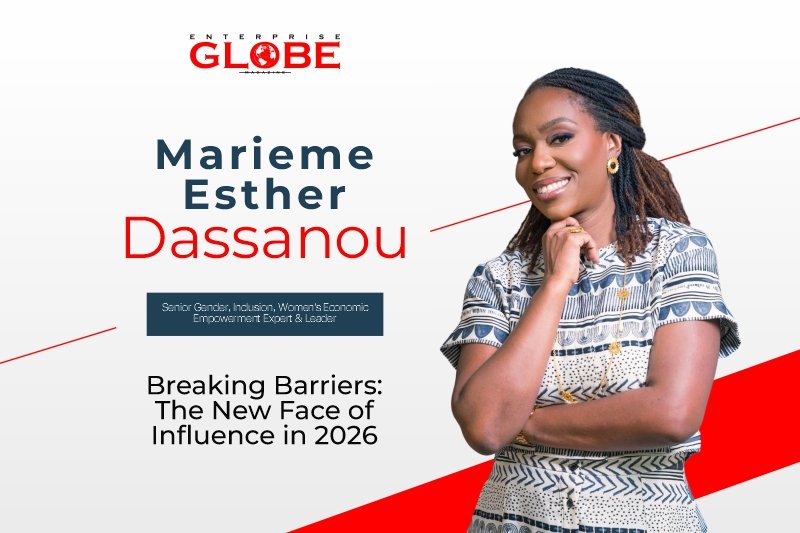
Marieme Esther Dassanou’s (Esther) journey is a remarkable story of leadership, resilience, inclusion, and economic transformation. With more than 18 years of experience across Africa and emerging markets, she has dedicated her career to creating opportunities for underserved communities, empowering women and helping institutions understand that inclusion is not only a moral responsibility but also a powerful driver of sustainable growth and economic success.
Throughout her professional journey, Esther has held senior leadership positions at globally respected organizations such as the Mastercard Foundation, the African Development Bank and the International Finance Corporation. These roles gave her more than professional recognition. They gave her a unique understanding of how systems evolve, how institutions operate and how meaningful change can be achieved across societies and economies.
Mentorship has become an important part of Marieme Esther Dassanou’s commitment to advancing gender professionals and experts. Through guidance, knowledge-sharing, and meaningful professional connections, she supports emerging and established practitioners in strengthening their leadership capabilities and expanding their impact. Her approach to mentorship goes beyond simply offering advice; it is about listening, sharing experience, encouraging confidence, and helping professionals recognise the opportunities available to them. By creating space for learning and collaboration, she contributes to the development of a stronger, more inclusive community of gender professionals equipped to influence organisations, communities, and wider social change.
Most recently, Esther served as the Director of Gender Programs at the Mastercard Foundation, where she led the development and implementation of the Foundation’s Gender and Inclusion Strategy across multiple African countries. Her work focused on empowering young women, increasing financial inclusion and ensuring that underserved populations had access to opportunities that could transform their lives.
For Esther, inclusion has never been just a social conversation. She strongly believes that when societies create opportunities for women and marginalized groups, economies become stronger, businesses grow faster and communities become more resilient. According to her, inclusion is not charity, it is smart economics.
Her leadership philosophy was shaped early in life by something she constantly observed around her. She saw women carrying families, businesses, and entire communities on their shoulders while often lacking equal access to opportunities, recognition, and decision-making power. This contradiction deeply influenced her perspective and inspired her commitment to creating systems where people, especially women, could fully realize their potential.
As her career progressed across countries and sectors, Esther realized that exclusion does not only affect individuals. It limits entire economies and institutions. She understood that true leadership is not about titles or authority alone. It is about helping people and organizations recognize possibilities where they once saw barriers.
These experiences became the foundation of her leadership style. Esther leads with both empathy and ambition, courage and humility, vision and responsibility. She believes leadership requires balance being able to push for transformation while remaining deeply connected to people and their realities.
One of the most defining lessons in her career was learning how to lead through resistance. Many of the initiatives she championed involved transforming long-standing institutional structures and cultural mind sets. Change is rarely easy, especially when it challenges deeply rooted beliefs about who deserves opportunities, who should lead, and who should benefit from economic systems.
She learned that resistance should not always be met with force. Sometimes, effective leadership requires patience, grace, strategic thinking and the ability to engage people in difficult conversations. Esther discovered that meaningful transformation often happens slowly, through persistence and continuous dialogue.
Another major realization in her journey was that inclusion work is often underestimated until organizations begin to see its measurable impact on performance and growth. This required her to become fluent in two different languages simultaneously: the language of values and the language of business strategy.
She learned how to connect inclusion with economic outcomes, performance metrics, investment opportunities, and organizational growth. By doing this, she was able to help institutions understand that diversity and inclusion are not separate from success they are essential to it.
At the same time, Esther believes leadership goes far beyond strategies, reports or targets. Leadership is fundamentally about people. It is about motivating teams, understanding individual strengths, building trust and helping others succeed. She believes that strong leaders know how to remain focused on goals while still showing empathy and emotional intelligence.
In today’s rapidly changing world, Esther believes the meaning of leadership itself has evolved. In 2026, leadership is no longer only about authority, expertise or visibility. Modern leaders must know how to navigate uncertainty, build trust, manage complexity and create environments where people can truly thrive.
Earlier in her career, Esther associated leadership strongly with performance and results. While she still believes execution and results are extremely important, she now understands that sustainable impact depends equally on how people experience leadership. People remember not only what leaders achieve, but also how those leaders made them feel throughout the journey.
Today’s leaders, according to Esther, must combine strategic intelligence with emotional intelligence. As the world experiences rapid economic, technological, social and geopolitical shifts, leaders must remain adaptable while staying deeply human.
Among the qualities she values most in leadership are integrity, courage, empathy, excellence and service.
Integrity is essential because leadership without trust eventually collapses. Courage is necessary because meaningful transformation often requires difficult conversations and uncomfortable decisions. Empathy allows leaders to connect with people and create environments where individuals feel respected and empowered to contribute fully. Excellence matters because vision without execution achieves little. Finally, service is central because Esther views leadership as stewardship using influence to create opportunities that benefit others beyond oneself.
One of Esther’s greatest strengths is her ability to connect inclusion with strategy, growth and performance in ways that resonate with governments, investors, corporations, foundations and communities alike. She brings together systems thinking and operational expertise developed through years of working across philanthropy, development finance and the private sector in more than 40 countries across Anglophone and Francophone Africa.
Her experience has helped her understand how institutions function, where bottlenecks emerge and how transformation can move from theory into real-world implementation. More importantly, she possesses the ability to see potential in individuals, organizations and markets even when others cannot yet fully recognize it themselves.
For Esther, leadership also comes with the responsibility of creating pathways for others. She is deeply committed to mentoring emerging leaders, especially young women navigating professional spaces where they may feel underestimated or overlooked.
She supports them by sharing opportunities, increasing visibility, opening doors and helping them build confidence. At the same time, she is honest about the realities of leadership. She does not romanticize it. Leadership requires resilience, discipline, emotional maturity, accountability and continuous learning.
Esther also believes mentorship should never be one-sided. While she values the guidance she received throughout her own journey, she equally values learning from younger generations. In her view, leadership today requires intergenerational collaboration and continuous exchange of perspectives.
Creating inclusive cultures, according to Esther, goes beyond public statements or symbolic gestures. Real inclusion is built through systems, behaviours, accountability and intentional leadership decisions.
She encourages organizations to ask important questions: Who is missing from the conversation? Who benefits from existing systems? Whose voices are influencing decisions? What invisible barriers still exist within institutions?
Building inclusive environments requires thoughtful approaches to recruitment, leadership development, decision-making, partnerships and resource allocation. Beyond policies and structures, Esther believes organizations must create psychological safety environments where individuals feel respected enough to express themselves without fear of exclusion or dismissal.
For her, inclusion should not exist as a side conversation within organizations. It should be integrated into how institutions think about innovation, talent, growth and long-term sustainability.
One of the greatest lessons Esther has learned is that transformation requires both patience and persistence. Real change rarely happens overnight. Systems resist change. Institutions resist change. Even people sometimes resist change because uncertainty creates discomfort.
She believes leadership is not simply about initiating transformation. It is about sustaining momentum long enough for that transformation to become deeply rooted within systems and cultures.
Esther also emphasizes the importance of remaining curious. In her opinion, the most dangerous leaders are those who stop learning, questioning and adapting. Leadership is not about having all the answers. It is about being willing to listen, evolve and continue growing.
Reflecting on her own journey, Esther shares an important message for future leaders, especially women. She encourages them never to shrink themselves to make others comfortable. Their voices, ideas, ambitions and perspectives are not “too much.” The world does not need smaller versions of talented individuals, it needs them fully and authentically.
She also reminds young professionals to trust the process. Many experiences that initially feel like setbacks eventually become preparation for greater opportunities. Growth is rarely linear, and some of life’s most valuable lessons emerge from unexpected challenges and detours.
Above all, Esther believes leadership is not about perfection. It is about courage, consistency, purpose and remaining grounded even during uncertainty. Her journey serves as a powerful example of how visionary leadership, empathy and inclusion can create lasting transformation across individuals, institutions and entire societies.
Today, Esther Dassanou continues to inspire global audiences through her work, her advocacy and her unwavering belief that inclusive growth is one of the strongest foundations for a better future. Her story is not only about leadership in business or development, it is about redefining leadership itself for a rapidly changing world.