In the IT and technology industry, people are at the centre of every system, process, and business decision. As organizations grow more complex, HR has moved beyond routine administration to become an important part of how companies build teams, develop talent, manage performance, and create an environment where people can do their best work. Behind these functions are HR professionals who understand that effective people management is not only about policies and processes, but also about creating a workplace where individual contributions connect with wider business goals.
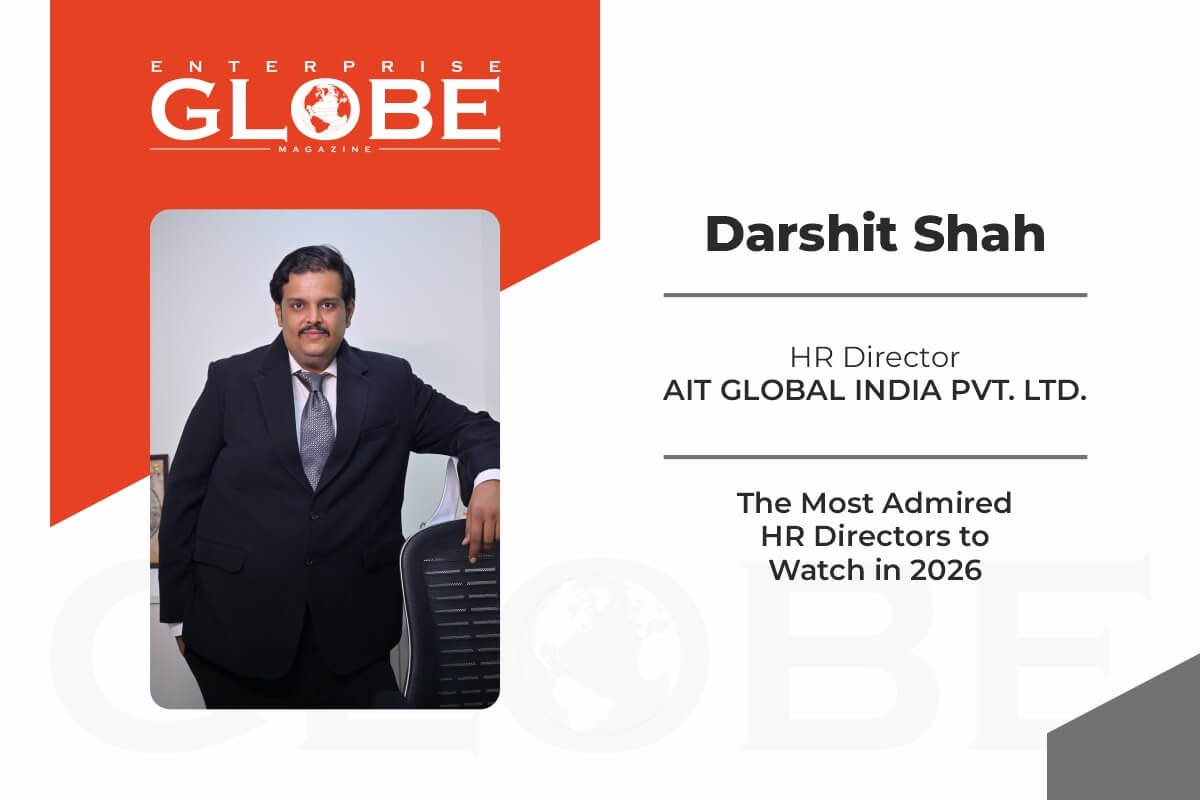
With nearly 19 years of experience in HR Operations across the IT and technology space, Darshit Shah, HR Director at AIT GLOBAL INDIA PVT. LTD., has built his career around this connection between people and organizational performance. His experience covers a broad range of HR responsibilities, from payroll management and pre-employment processes to campus recruitment, part-time employee management, events, and new hire orientation. Across these areas, he has developed a practical understanding of what it takes to keep HR operations organized while ensuring that employees have the support and clarity they need from the beginning of their journey.
A significant part of Darshit’s work has also focused on bringing greater structure to performance management. He has worked on aligning individual and organizational goals by introducing a new performance management process and incorporating KPIs into the evaluation framework. The approach reflects his belief that performance becomes more meaningful when employees understand what is expected of them and how their contribution connects with the organization’s larger direction.
His experience in payroll has added another important dimension to his HR leadership. Over the years, he has managed a wide range of payroll operations, including preparing payroll documentation, reconciling payroll accounts, and addressing discrepancies. While much of this work happens behind the scenes, its importance is felt directly by employees, making accuracy, consistency, and timely resolution essential.
Together, these experiences have shaped Darshit’s approach to HR as one that combines operational discipline with an understanding of people. His career reflects the many layers of modern HR, where strong processes support employees, clear performance expectations help teams move forward, and everyday attention to detail contributes to a more dependable organization.
A Career Built Through Ownership
Darshit’s nineteen-year journey in HR did not begin with a long-term career plan. When he joined AIT Global India in 2007 as a fresher in an administrative executive role, his immediate priority was simply to find a job, earn, and begin gaining professional experience. What started as a practical decision gradually became a journey of learning, responsibility, and growth within the same organization.
As AIT evolved, so did Darshit’s responsibilities. Starting with administration, he gradually moved into HR and became involved in employee onboarding, attendance, leave management, recruitment, payroll, compensation and benefits, compliance, and employee relations. His role also exposed him to finance, legal matters, banking requirements, and coordination with external financial professionals. This experience allowed him to understand the organization from several different perspectives rather than viewing HR as a function operating separately from the business.
A significant part of his journey involved building processes from the ground up. When he joined, AIT was still developing its internal systems, with many HR and administrative processes being handled manually. Darshit became closely involved in establishing HR policies, legal and labour compliances, and other foundational practices as the organization grew.
Working closely with employees and management also placed him in an important connecting role. He understood employee concerns while remaining aware of management expectations, which gradually shaped his approach to people and leadership.
As he puts it, his career was “not built by moving from one job to another, it was built by taking ownership of one opportunity after another.”
The Culture Behind the Capability
What makes AIT India distinctive, according to Darshit, is not technology alone but the culture built around its people. Technology and systems can be acquired, redesigned, or replaced, but creating an environment where people understand the business, take ownership, and contribute to growth requires a deeper commitment.
That belief shapes HR’s role within the organization. Darshit sees HR as more than a function focused on recruitment and employee administration. It needs to understand workforce planning, workflows, compliance, and organizational effectiveness while staying connected to the company’s broader direction.
The key question, in his view, is simple: Do we have the right people, capabilities, and environment to achieve where the business wants to go? Rather than asking only what employees need, HR must also understand what the business needs from its people to reach its next milestone.
Connecting Individual Growth with Business Purpose
Darshit believes people take greater ownership when they can see how their own growth contributes to the larger objectives of the organization. His approach is to create a clear connection between organizational goals, departmental priorities, and individual responsibilities, with business leaders and managers taking ownership of that alignment while HR provides the structure through goal setting and performance processes.
He also believes performance should not become a conversation reserved for the annual appraisal cycle. His own early experience at AIT, when the company had a relatively small workforce, allowed him to maintain regular one-to-one connections with employees. Those conversations went beyond professional responsibilities and often included career concerns and personal difficulties. That closeness helped him understand people better and made employees more comfortable approaching him.
At the centre of his approach is a simple belief: people perform better when they understand not only what they are doing, but why their work matters. Once employees can see the purpose behind their responsibilities and understand how their contribution fits into the larger business, performance and ownership can develop more naturally.
This also shapes the way Darshit views HR’s relationship with employees. He believes people should see HR as part of their team rather than as a distant management function. When employees feel that HR understands their challenges, listens to them, and connects their individual aspirations with the organization’s direction, the relationship becomes more meaningful.
Performance is More Than a Number
As AIT Global India grew, Darshit saw the need for its performance management approach to evolve with it. Describing someone simply as a “good performer” or someone who “needs improvement” was no longer enough. He introduced KPIs to bring greater clarity around objectives, expectations, and accountability, while keeping the individual conversation at the centre of the process.
Darshit is clear that a KPI should not become a scorecard used merely to judge people. A rating of five, eight, or ten may indicate where someone stands, but it does not explain the complete picture. What matters is understanding what was expected, why a particular result was achieved or missed, and where the employee can improve.
That is why he sees KPIs more as a compass than a scorecard. Regular one-to-one conversations allow managers and employees to discuss responsibilities, challenges, and progress rather than waiting until the formal appraisal cycle. The personal connection, in his view, makes performance management more meaningful and helps employees understand what they can do differently.
Darshit also recognizes that performance comes with a learning curve. An employee may receive a lower overall rating while demonstrating strong ownership and capability in the core responsibilities of the role. Someone may need improvement in presentation or behavioural aspects while still showing the right attitude and complete ownership of their work.
Hiring for Potential, Not Just the Present
Darshit’s approach to recruitment begins with looking beyond a candidate’s immediate skill set. Whether hiring a fresher or an experienced professional, he pays close attention to attitude, ownership, and the willingness to learn. His central question is simple: can this person do the job, and can this person grow with the job?
He believes a candidate who only follows an existing process may be able to complete assigned responsibilities, but may not necessarily bring new thinking to them. Darshit looks for people who can go beyond the obvious answer, offer their own perspective, and think about different ways of approaching a task. That ability to question, explore, and learn can become increasingly valuable as the role and business evolve.
His approach to employee experience follows the same people-focused thinking. Over the years, he has worked on structured induction, employee communication, leadership interactions, engagement initiatives, town halls, open-house forums, and platforms where employees can share ideas and contribute suggestions.
For Darshit, a meaningful employee experience rests on three things: clarity, respect, and opportunity. Employees need to understand what is expected from them, feel that they are treated fairly, and see a genuine path for growth.
He also views engagement as something deeper than simply keeping employees happy through activities. The real objective is to create a positive workplace where people feel valued and motivated to contribute. When employees understand their role, feel respected, and believe they have room to grow, engagement becomes part of the culture rather than just another HR initiative.
Staying Fair When Things Get Difficult
Darshit’s approach to employee relations is rooted in the trust he has built throughout his long association with AIT Global India. Having started his career with the company in 2007 and continued his journey there, he sees trust as something earned through consistency rather than simply through agreement.
He believes trust is not built by always saying yes. It comes from being fair, transparent, and willing to communicate honestly, even when the answer is difficult. That principle also means that HR sometimes has to challenge difficult situations and have candid conversations with senior management, founders, or CEOs.
When an issue involves compliance, fairness, or basic human considerations, Darshit believes HR has a responsibility to address it rather than remain a passive observer. His role, however, is not to create a divide between employees and management. The objective is to understand both sides and work towards a solution that is fair to the individual while also being responsible to the organization.
This balance is central to how he approaches workplace concerns. Employee relations, in his view, cannot be reduced to simply supporting employees or protecting management. It requires listening, understanding the circumstances, maintaining transparency, and finding a practical way forward.
His belief is that the outcome should not be a one-sided victory. A healthy workplace is one where both the organization and its people can move forward with clarity and mutual trust.
Understanding the Business Before Shaping HR
Darshit’s understanding of strategic HR has been shaped by the different phases he has witnessed at AIT Global India since joining in 2007. He has seen the organization navigate growth as well as difficult periods, including a phase of downsizing during the recession. During that uncertain period, he approached the founder for direction and was asked to stay patient and trust the organization’s ability to recover. As business gradually picked up, Darshit became increasingly involved in understanding how growth, risk, projects, and organizational structure influenced people requirements.
That experience shaped a fundamental belief in his approach to HR: understanding people is not enough if HR does not understand the business. He made it a point to sit with business teams, understand their operations and client requirements, and then determine what kind of talent and structure would support them. Even when he was recruiting for a business unit outside his direct function, he would spend time with the team to understand its work before approaching the people requirement.
He believes an HR leader needs to be comfortable discussing productivity, costs, workflows, business growth, organizational structures, technology, and risk alongside traditional HR responsibilities. Once HR understands how the business operates, it can better understand what employees need and build strategies around both.
This understanding becomes equally important as technology and skill requirements continue to change. Technical expertise will remain important, but Darshit sees adaptability, problem-solving, communication, collaboration, business understanding, and continuous learning becoming increasingly important.
Talent Needs a Reason to Stay
In Darshit’s view, the people challenges facing the technology sector are closely tied to how quickly the industry itself changes. Technology requirements can shift rapidly, business models evolve, and the skills organizations need today may require upgrading tomorrow. This creates ongoing pressure around talent acquisition, retention, capability building, and workforce planning.
He believes these challenges cannot be addressed through recruitment alone. Compensation and benefits have to remain aligned with market realities while maintaining fairness within the organization. Talent acquisition, performance management, learning and development, compensation, employee engagement, and retention therefore need to work together rather than operate as separate HR activities.
Yet Darshit sees the deeper challenge differently. Finding talent is only one part of the responsibility; creating an organization where that talent has a reason to stay is equally important.
That reason can come from several places: opportunities to grow, confidence in the organization, meaningful work, and most importantly, trust in the people leading them. Whether the reporting leader is a manager, CEO, or founder, employees need to believe in the person they are working with and the direction they are being given.
Without that trust, even a capable employee may find it difficult to give their best to the organization. This is why Darshit looks at retention as something that begins with the overall employee experience rather than ending with compensation or a successful hiring process.
Building People Who Can Stand on Their Own
Darshit describes his leadership style as simple: he does not want to build a team that depends on him. His aim is to help people become stronger because they have had the opportunity to learn, explore, and take responsibility. He believes constant micromanagement can eventually affect productivity, cost, and business goals, so he gives his team space to work and develop confidence.
His own journey within AIT reflects that transition. There was a time when he handled a wide range of responsibilities across HR, recruitment, administration, and coordination with accounts. Over time, he began sharing his knowledge and creating a team capable of carrying those responsibilities independently. Today, he takes confidence in knowing that operations can continue even when he is not available. He gives the example of payroll, where his team can manage the process without depending on his sign-off.
Knowledge sharing is central to this approach. Darshit has never believed that keeping knowledge to himself makes his position more secure. Instead, he shares openly and encourages the team to do the same. As knowledge and experience move in both directions, people become more capable and the team becomes stronger.
He also accepts that learning involves mistakes. What matters to him is honesty, accountability, and the willingness to learn from them rather than hide them or shift blame. A mistake can become a learning opportunity when it is acknowledged and not repeated.
Growing People, Growing Organizations
After nearly two decades with the same organization, Darshit believes people growth and organizational growth cannot be separated. Processes create structure, technology brings efficiency, and strategy provides direction, but people ultimately bring everything together. His focus remains on building stronger people practices, developing teams into business partners, improving processes, and ensuring HR evolves alongside the business.
Even after two decades, Darshit continues to see himself as a learner who is still building and looking for ways to contribute. His own career has taught him not to rush toward defining where a career should end, but to focus on becoming valuable in every role and opportunity.
That philosophy reflects his journey at AIT, where an entry-level opportunity developed into years of learning, responsibility, and leadership. His message is simple: “Don’t be in a hurry to define where your career will end. Focus on becoming valuable in every role you are given.”
His guiding belief, “Together we can, together we will,” captures his view that meaningful organizational progress happens when people learn, contribute, and grow together.