
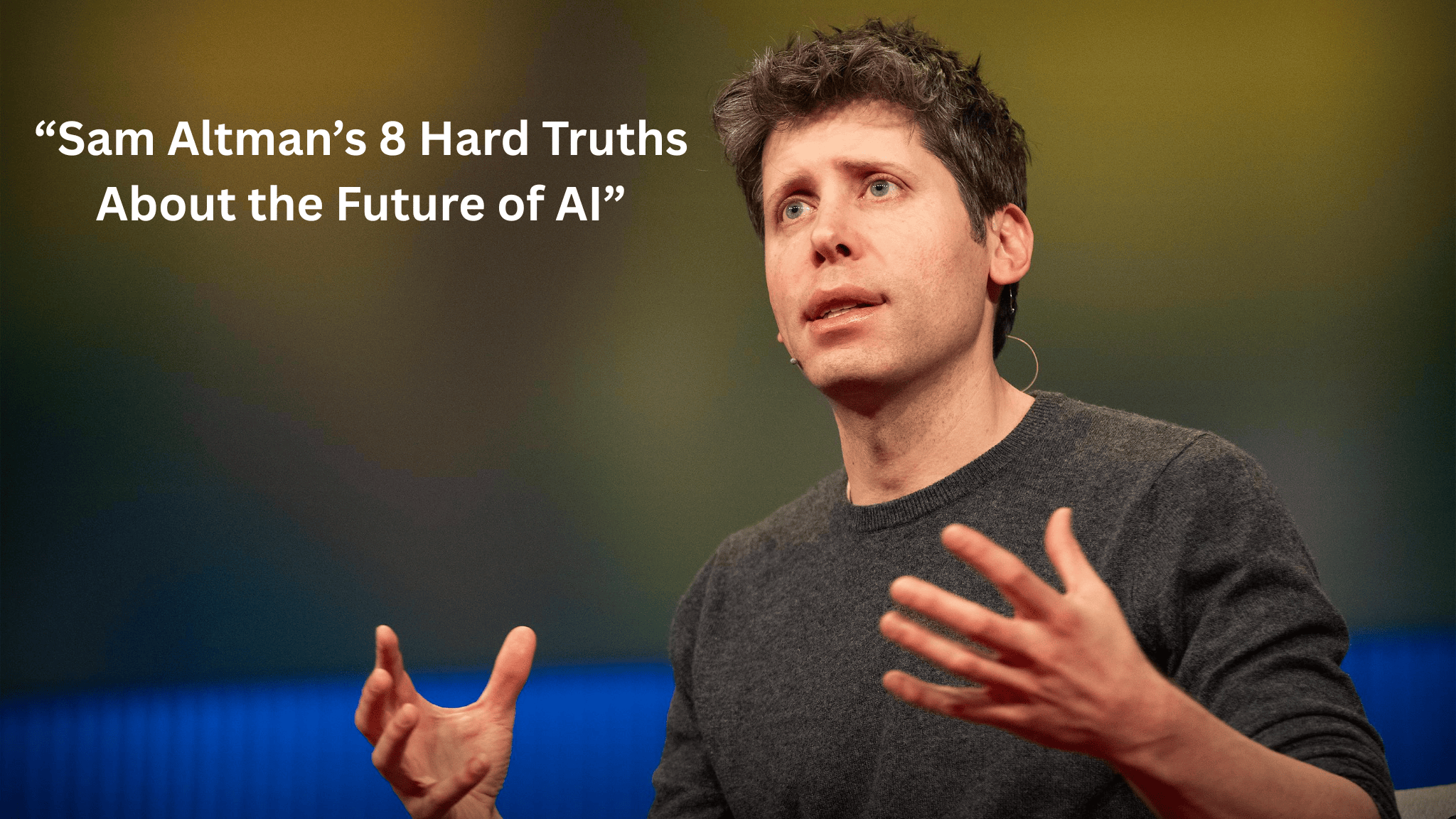
Sam Altman’s 8 Hard Truths About the Future of AI – What It Really Means in 2026
Credits: Shane Collins | Medium
No Hype – Just Reality Checks From the AI CEO
OpenAI CEO Sam Altman a central voice in artificial intelligence recently shared a set of blunt truths about where AI is headed. Instead of marketing slogans or speculative hype, these insights focus on the practical challenges and societal shifts that will shape AI’s evolution in 2026 and beyond.
These truths aren’t abstracts they touch on jobs, skills, energy, compute, and how humans must adapt in a world driven by exponential technology.
1) The Nature of Software Engineering Is Changing
Altman made it clear that while AI won’t eliminate software engineering entirely, the role will fundamentally transform. Instead of writing lines of vanilla code, developers will become problem identifiers and solution integrators — working alongside AI tools that write and optimize code automatically.
2) Skills Have a Short Half-Life
In 2026, the skills that make you valuable today may no longer be differentiators in just 2–3 years. Continuous learning isn’t optional it’s survival. Professionals will need a learning portfolio, constantly updating their abilities and focus areas.
3) The “10x Engineer” Is Being Redefined
Altman challenged the myth of the lone genius developer who writes massive amounts of code. In the AI era, the rare skill isn’t speedy coding it’s identifying the right problems to solve, since AI handles repetitive code generation.
4) The Bottleneck to AI Progress Isn’t Talent It’s Compute and Energy
AI’s future progress isn’t constrained only by clever algorithms or smart engineers — it’s bottlenecked by raw compute power and energy infrastructure. Nations and companies that control energy and high-performance compute will define the pace of advancement.
5) AI Won’t Replace Humans But It Will Transform Work
Altman has said that AI won’t simply replace jobs; it will change them. People who adopt and collaborate with AI tools will outcompete those who resist. This means human creativity, judgment, and domain understanding become sources of value that AI cannot easily replicate.
6) AI Adoption is Still Extremely Low in Real Production Systems
Despite all the buzz, enterprise AI adoption remains limited. Some reports indicate that only a small fraction of companies have successfully integrated AI into core processes, meaning there’s still a large gulf between pilot projects and real value creation.
7) AI Will Force New Trade-offs
With limited compute resources and energy, society will face tough choices: prioritize AI for healthcare breakthroughs or for free global education? Altman’s comments highlight that AI progress isn’t inevitable it’s shaped by where we choose to allocate power and infrastructure.
8) Humans Must Retain Decision-Making Control
As AI becomes more integrated into workflows, Altman has warned against outsourcing critical thinking and judgment entirely to machines. The risk isn’t only job loss; it’s losing agency and autonomy in how decisions are made.
Altman’s truths underscore one central theme: AI’s progress isn’t just a technical phenomenon it’s a societal challenge. The winners in 2026 won’t be those who merely adopt tools; they’ll be those who reshape their learning, decision-making, and strategic thinking for an AI-augmented world.
Follow Enterprise Globe Magazine for deeper insights on how AI is reshaping industries, careers, and global markets — with expert breakdowns that go beyond buzzwords.