“Environmental problems don’t stop at borders and neither should science!”
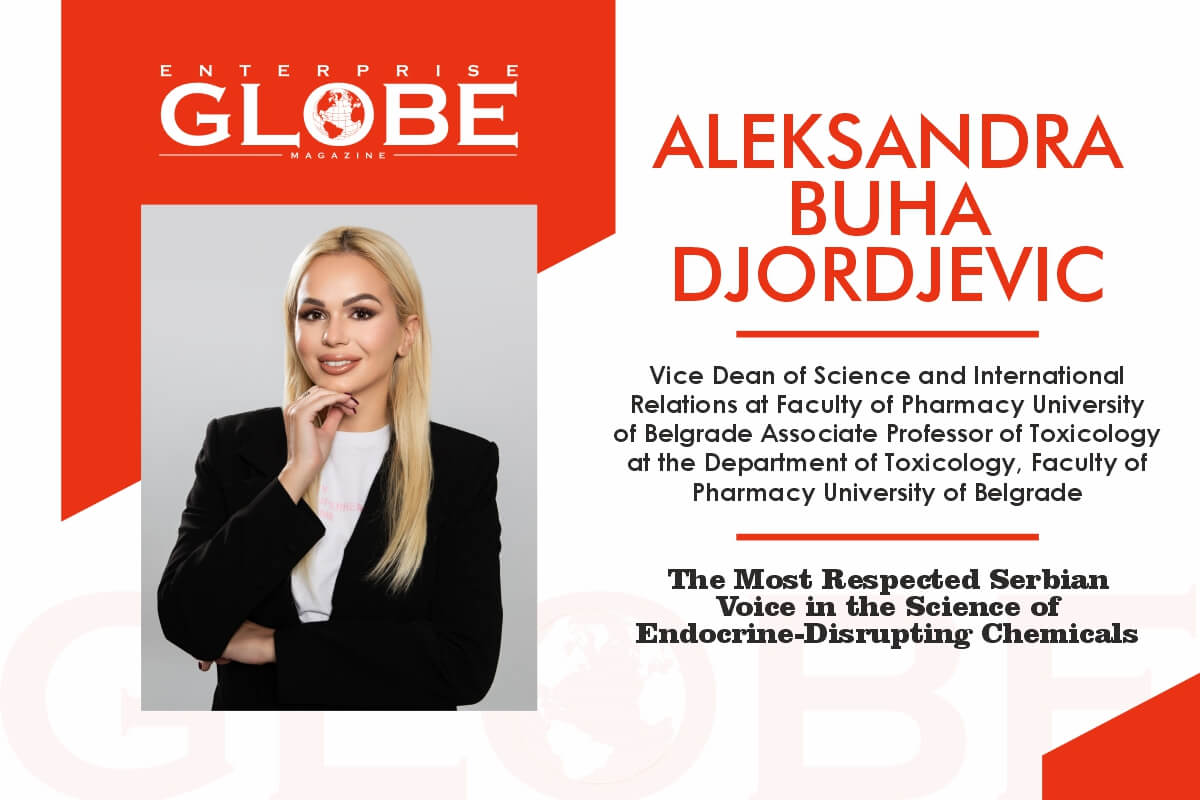
Dr. Aleksandra Buha Djordjevic is one of Europe’s leading voices in the science of endocrine-disrupting chemicals (EDCs), a toxicologist whose work bridges molecular mechanisms, population health, and concrete preventive action. As an Associate Professor and Vice Dean for Science and International Relations at the University of Belgrade – Faculty of Pharmacy and an internationally recognized researcher, she has built a career defined by scientific rigor, societal relevance, and an everlasting commitment to protecting vulnerable populations.
She graduated at the University of Belgrade-Faculty of Pharmacy with one of the highest grades in her generation and went on to complete a PhD in Toxicology at the same Faculty focused on the long-term effects of mixtures on endocrine health, Her early work laid the foundation for what would become a wide-ranging research portfolio oriented toward understanding how chemical mixtures and real-life exposures shape human health.
From Mechanistic Toxicology to Translational Science
Over time, her research expanded from laboratory studies to a comprehensive translational approach that connects toxicology with public health practice. Today, she is internationally recognized for examining how chronic low-level exposures to toxic metals, PFAS, bisphenols, and other EDCs influence endocrine and metabolic health across the lifespan. At the core of her work lies the concept of the human exposome the total of all environmental exposures a person encounters over their lifetime. By decoding this complex puzzle, Aleksandra aims to reshape our understanding of how the environment influences health and disease. Her goal is ambitious yet deeply human: to translate scientific insight into prevention, protection, and better policy.
“Behind every data point is a human life, science must reflect that.”
As the Principal Investigator of several national and international projects, Dr. Buha Djordjevic develops interventions designed to profoundly improve early-life health trajectories. Her team creates evidence-based educational tools, workshops, and practical guidance materials for pregnant women, breastfeeding mothers, and young families. The goal is simple and bold: empower parents to reduce everyday chemical exposures and give children a healthier start. These initiatives build on her longstanding commitment to public health and positioned her as a trusted communicator of risk-reduction practices.
Dr. Buha Djordjevic’s translational work extends beyond the public and into clinical systems. Currently, she leads a “training-the-trainers” model designed to equip gynecologists, endocrinologists, pediatricians, and nurses with up-to-date knowledge on endocrine disruptors. Her approach tends to integrate EDC awareness into routine prenatal and pediatric practice, ensuring that exposure prevention becomes a standard part of clinical counseling. By collaborating with physicians, researchers, and public health practitioners, she helps bridge a longstanding gap between toxicology research and health-care delivery.
Scientific Impact and Recognition
With more than 120 peer-reviewed publications, over 4,800 citations, and an h-index of 36, Dr. Buha Djordjevic ranks among the top toxicologists of her generation. She has appeared on Stanford University’s list of the Top 2% of Scientists Worldwide for five consecutive years.
Her work spans mechanistic toxicology, endocrine disruption, carcinogenesis, mixture toxicology, and risk assessment. She has pioneered the application of benchmark dose modeling to human observational data, demonstrating dose–response relationships between real-life chemical mixtures and endocrine outcomes.
An International Academic Voice
Dr. Buha Djordjevic is deeply embedded in global scientific and educational networks. She currently holds several prestigious international teaching and visiting appointments: Visiting Professor atSchool of Medicine, University of Sassari, Italy, Adjunct Professor at Oklahoma State University Center for Health Sciences, USA, Adjunct Professor, School of Environment and Sustainability, University of Saskatchewan, Canada, President of the PhD Thesis Defense Committee, University of Modena and Reggio Emilia, Italy and many more. In addition, she serves as Academic Chair for Global Health for University of Belgrade within the Circle U. European University Alliance, where she co-creates interdisciplinary curricula and leads initiatives that connect environmental health, planetary health, and sustainable development across multiple universities.
These roles amplify her impact beyond research, shaping the next generation of toxicologists, clinicians, and public health practitioners.
Leadership, Networks, and Advocacy
As Global Coordinator for the HEEDS EDC Network, she leads the establishment of new working groups worldwide and spearheads initiatives aimed at research, education, and policy transformation. Under her leadership, the Serbian chapter of HEEDS, the first in the region, has become a hub for interdisciplinary collaboration and public outreach. Furthermore, she has served as a member of EDC working group of European Society of Endocrinology for many years
A Scientist Working for Society
Despite her international achievements, Dr. Buha Djordjevic’s work remains grounded in a simple guiding principle: science should make life better for people. Whether developing new exposure-reduction tools, educating clinicians, analyzing population-level risks, or guiding students through complex scientific landscapes, she brings together rigor, empathy, and a deeply held sense of responsibility.
She is also a passionate advocate for women in science, mentoring young researchers and encouraging them to step forward with confidence. Her approach blends academic excellence with compassion guiding her students to think critically, act ethically, and remember that every dataset ultimately represents a human story.
Her career represents a powerful model for modern toxicology, one that extends from the molecular level to community impact, from the classroom to the clinic, from Serbia to global networks.
In an era defined by increasing chemical complexity, Dr. Aleksandra Buha Djordjevic offers clarity, leadership, and hope. By connecting cutting-edge science with practical, accessible solutions, she ensures that research does not remain confined to journals, but reaches the people who need it most families, clinicians, and communities.
Her work stands as a testament to what science can achieve when guided by purpose, integrity, and a commitment to protecting future generations.