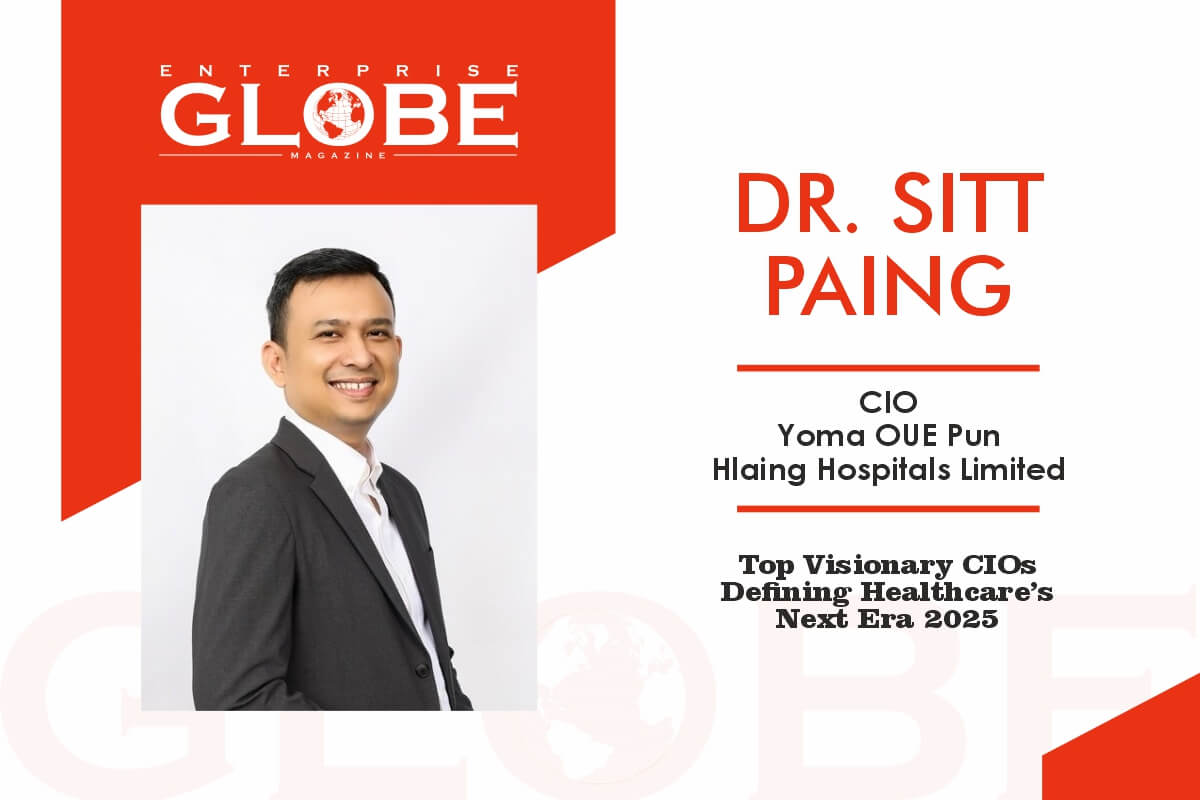
Some stories begin with grand ambitions. Others start with a simple act of curiosity a raised hand, a willingness to learn, a quiet “yes” to the unknown. For Dr. Sitt Paing, Chief Information Officer of Pun Hlaing Hospitals Group in Myanmar, his defining chapter began exactly that way.
Years ago, when his CEO, Dr. Gershu Paul, gathered physicians to volunteer for a ground breaking digital radiology project the first of its kind in the country, Dr. Paing didn’t hesitate. The project aimed to introduce a modern Radiology Information System and Picture Archiving and Communication System (RIS/PACS).
“I raised my hand instantly,” he recalls with a smile. “I had no idea what RIS/PACS meant, but I knew I wanted to learn.”
That one decision changed the trajectory of his career. What began as an experiment quickly evolved into a lifelong mission: using technology to humanize healthcare. The journey wasn’t easy. A doctor by training, he had to learn the language of code, system workflows, and digital architecture, all while staying true to the compassion that defines medicine. Yet, with persistence, mentorship, and relentless curiosity, he turned that challenge into his greatest strength.
Over time, the doctor who once knew little about technology became the technologist leading doctors. Under his guidance, Myanmar saw the successful implementation of its first fully digitalized radiology system and a modern electronic medical record (EMR) platform transforming how hospitals deliver and document care. But for Dr. Paing, the goal was never just about digitization. It was about empathy.
“Technology should never replace human connection,” he says. “It should enhance it make care more accessible, more transparent, and more humane.”
For Dr. Paing, leadership in 2025 and beyond is no longer about command or hierarchy. It’s about love, agility, and purpose. In a world where technology accelerates faster than human adaptation, leaders must not only manage systems but also nurture people through change.
“Leadership today isn’t about authority,” he reflects. “It’s about creating clarity in chaos and compassion in complexity.”
In his early years, Dr. Paing admits he was a perfectionist structured, detail-oriented, and process-driven. Over time, he realized that while systems are important, resilience comes from people, not policies. Today, his leadership philosophy centers on trust, collaboration, and collective intelligence.
“I see myself less as a commander and more as a gardener,” he says. “My role is to create the right conditions to plant seeds, nurture growth, and let people bloom in their own way.”
In an industry where every decision impacts lives, Dr. Paing’s moral compass is guided by timeless values honesty, transparency, accountability, and patience. But above all, he holds one principle above the rest: a learning mindset.
“No matter how much we know, medicine and technology evolve faster than any individual can keep up,” he explains. “The only way forward is to stay humble, stay curious, and keep learning.”
It’s this mindset that allows him to bridge two worlds the heart of a clinician and the mind of a technologist. This dual perspective makes him a rare kind of leader, capable of translating between doctors, engineers, and executives aligning care, code, and commerce into one unified vision
Leading digital transformation in Myanmar an emerging market with limited resources has shaped Dr. Paing’s innovative spirit. Where others might see constraints, he sees opportunities to design smarter, simpler, and more compassionate systems.
“True innovation isn’t about having more,” he says. “It’s about doing more with what you have designing solutions that are practical, affordable, and meaningful.”
His projects reflect that ethos. From mobile apps that simplify patient engagement to data-driven systems that enhance hospital operations, his initiatives have consistently aimed to make healthcare more transparent, efficient, and human-centered. In every design, every workflow, there’s one constant: empathy.
Every step of Dr. Paing’s journey has been shaped by mentorship. He often credits leaders like Dr. Gershu Paul for demonstrating what servant leadership truly means leading not through control, but through trust and listening.
“Real mentorship isn’t about telling people what to do,” he says. “It’s about helping them discover what they can do.”
Today, Dr. Paing pays that wisdom forward. He mentors young healthcare professionals and managers who aspire to bridge medicine and technology just as he once did. But to him, mentorship isn’t confined to formal programs or scheduled meetings.
“It happens in everyday conversations, in shared challenges, even in quiet moments of reflection,” he says. “It’s about creating a culture where people feel safe to learn, make mistakes, and grow.”
His leadership style reflects that belief. He gives his teams the freedom to experiment, fail safely, and learn publicly. In his organization, failure isn’t punished it’s reframed as feedback.
“Leadership should be a multiplier,” he adds. “When one person grows, the whole organization evolves.”
In Myanmar’s diverse workforce, inclusivity isn’t just a buzzword,it’s a necessity. For Dr. Paing, inclusion starts with psychological safety creating spaces where people feel heard and valued, regardless of title, background, or experience.
“We don’t just celebrate diversity,” he says. “We learn from it. Because our patients are diverse too and the more perspectives we bring to the table, the better we can serve them.”
To him, inclusion isn’t a policy; it’s a daily act of respect. It’s in how people listen to each other, how decisions are made collaboratively, and how empathy becomes a shared language across departments.
After years of leading people, projects, and transformation, Dr. Paing has learned that leadership theories are useful but limited. “Books can prepare you for one percent of what leadership really is,” he says with a laugh. “The rest is learned through experience through mistakes, reflection, and emotional balance.”
Whether in crisis or calm, he believes a leader’s job is to stay centered. “When everything feels uncertain, people look to leaders not for control, but for clarity,” he explains. “That clarity comes from staying grounded in purpose.”
For him, purpose is simple yet profound: to build a better Myanmar through equitable and digitally empowered healthcare.
Beyond the boardrooms and data dashboards, Dr. Paing’s most cherished title is father. His one-year-old daughter, he says, is both his anchor and his inspiration.
“She’s my reminder of why I do what I do,” he says softly. “Every innovation, every decision it’s all for the next generation.”
Fatherhood has deepened his empathy. It reminds him that healthcare isn’t just about patients — it’s about families, communities, and the people behind every statistic. It’s what fuels his drive to create systems that are not just efficient, but also compassionate.
If he could speak to his younger self the young doctor just beginning his journey Dr. Paing would offer one piece of advice: “Learn voraciously, and start early.”
“Once life fills with responsibilities, time becomes your rarest resource,” he reflects. “Skills compound like interest, and curiosity is the best investment you can ever make.”
He encourages young leaders to prioritize growth over speed. “Success isn’t about how fast you move,” he says. “It’s about how meaningfully you grow and how many people grow with you.”
Looking ahead, Dr. Paing envisions a Myanmar where healthcare is both digitally advanced and deeply human. A system where every patient experience is informed by data, guided by empathy, and powered by access. A world where leadership is measured not by titles or authority, but by integrity, inclusion, and impact.
His story from physician to digital pioneer is more than a professional evolution. It’s a reminder that technology and humanity are not opposites, but partners. And that the true heart of innovation lies not in algorithms or automation, but in empathy.
“Transformation doesn’t start with technology,” Dr. Paing says. “It starts with people who care enough to imagine something better and then build it.”